Your Project Needs Developers — But Do You Need to Hire Them Permanently?
A business can have a good product idea, an existing application, or a growing technology roadmap and still face the same problem: there aren't enough developers to move the work forward.
At that point, the obvious answer seems to be hiring more people.
But hiring a developer permanently isn't always the only way to increase development capacity.
Depending on the project, timeline, technical requirements, and expected workload, a business may choose to:
- Build an internal development team,
- Bring in dedicated developers, or
- Combine an internal team with external developers (Hybrid model).
The important question isn't simply “Which option is cheaper?”
It's: “What type of development team does this project actually need?”
That is the strategic decision this guide helps businesses understand.
Start With the Work, Not the Hiring Model
Before deciding how to hire developers, look closely at the work itself. Ask yourself these practical questions:
- Is this a long-term product or a short-term project?
- Do you need one developer or a complete development team?
- Are you missing a particular technical skill?
- Is your existing team overloaded?
- Will the workload remain the same six months from now?
- Do you already have someone managing the technical work?
- Do you need developers immediately or can you spend time recruiting?
These questions can completely change the right hiring approach. For example, a company building a product that will be maintained for many years may want strong internal ownership. Another company may already have a technical lead but temporarily need additional React, Node.js, .NET, or other specialized development expertise. The two situations shouldn't necessarily use the same hiring model.
Three Ways to Add Development Capacity
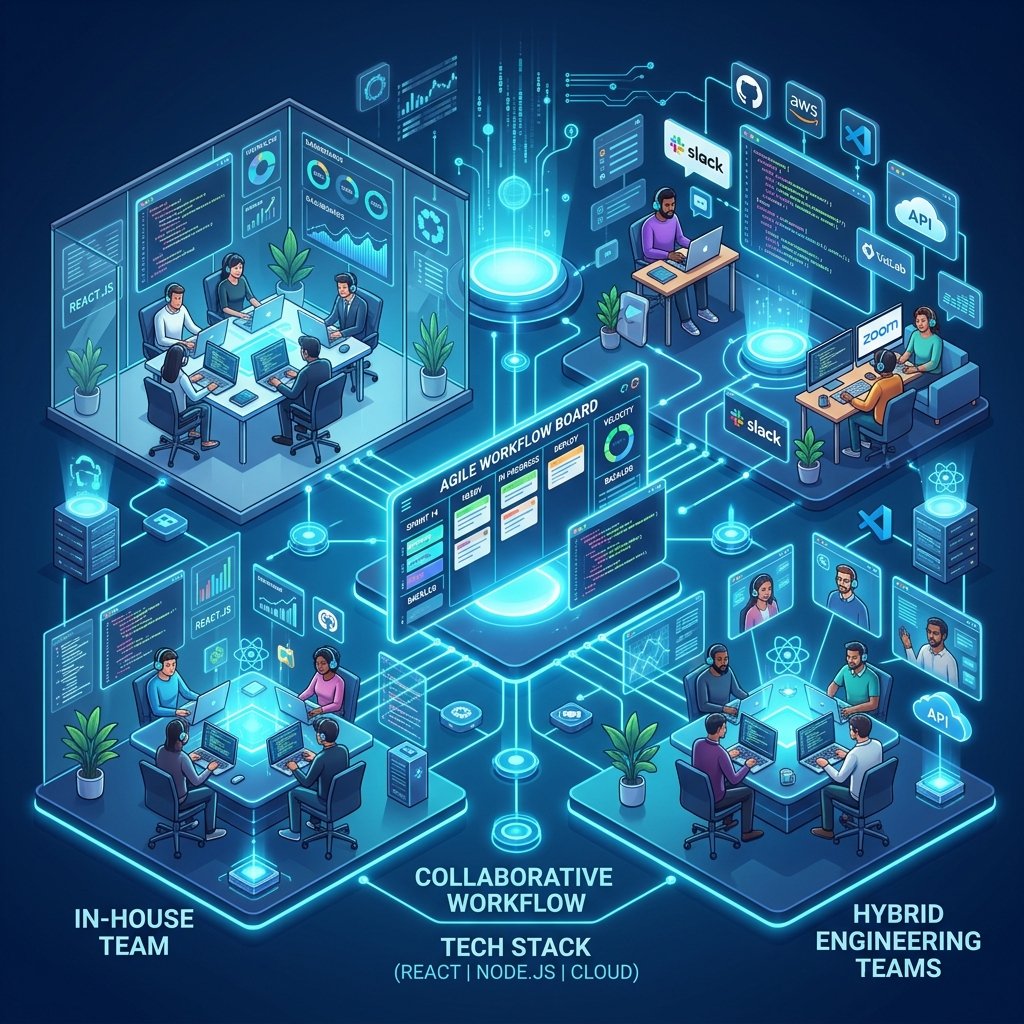
Instead of immediately comparing only two options, let's explore the three practical engineering models used by modern technology teams:
The company directly hires developers as full-time employees. This provides direct involvement in recruitment, management, company culture, and long-term product knowledge. It makes sense when software development is a permanent and central pillar of the company's continuous operations.
A business works with a technology partner to bring developers into its project or development workflow for an agreed period. The developers work according to the client's requirements while the technology partner handles employment, infrastructure, and resource-side responsibilities. This is especially useful when a company needs immediate technical capacity without creating long-term permanent overhead.
This is where things become especially powerful. A company keeps its core technical leadership and strategic architects internally and adds external dedicated developers when additional sprint capacity or niche technical skills are required.
Internal Core Team
- Product Owner
- Technical Lead / Architect
- Core Product Developers
Extended Dedicated Team
- React.js Developer
- Node.js / Backend Developer
- .NET Developer
- QA & Automation Engineer
This model allows the internal team to maintain product direction, vision, and security standards while external developers dramatically accelerate sprint delivery.
The Better Question Isn't "In-House or Dedicated?"
Instead of a generic comparison, ask: What problem are you trying to solve right now?
| Your Situation | Possible Approach |
|---|---|
| You need permanent product ownership | In-house |
| You need additional developers for an existing project | Dedicated |
| You need a specific technical skill (e.g. React, Node, .NET) | Dedicated |
| Your development workload changes frequently | Dedicated / Hybrid |
| Technology is a core permanent capability | In-house |
| You already have technical leadership but need more delivery capacity | Hybrid |
| You are building a temporary product or feature | Dedicated / Project-based |
This decision framework is much more practical than simply declaring one model unconditionally superior to the other.
What Usually Gets Overlooked When Hiring Developers?
Don't focus solely on base salary. A comprehensive developer hiring decision also involves multiple organizational dimensions:
- Recruitment Time: How long will it take to source, interview, vet, and hire the right person? (Often 2 to 4 months for in-house roles).
- Technical Fit: Does the developer actually possess the battle-tested experience your current tech stack requires?
- Management Effort: Who will handle sprint planning, task allocation, code reviews, communication, and coordination?
- Continuity & Knowledge Risk: What happens if an in-house developer leaves mid-sprint with crucial domain knowledge?
- Workload After the Project: Will you still have enough engineering workload to justify a permanent salaried position 6 months down the road?
- Scaling Agility: What happens when your development requirements need to scale up quickly for a major release or scale down between quarters?
Evaluating these factors gives decision-makers a complete business perspective rather than just looking at isolated hourly numbers.
When Hiring a Dedicated Developer Can Make Sense
A dedicated developer or extended engineering team is worth considering when:
- Your internal engineering team is overloaded and missing deadlines;
- You need a particular technology skill (e.g. React.js, Node.js, .NET, cloud architecture) without long training cycles;
- Your project has a temporary increase in workload or strict delivery milestone;
- You want to initiate development immediately without building an entire internal recruiting pipeline;
- You need additional developers for a defined milestone or engagement period;
- You want to extend an existing development team with vetted talent.
Realistic Scenario: A company with an existing product team may not need to hire five permanent full-time developers simply because a six-month intensive feature rollout requires additional capacity.
When an In-House Developer May Make More Sense
For complete credibility and sound strategy, direct in-house hiring remains the optimal choice in specific scenarios:
- The engineering role is required continuously year after year;
- The engineer needs deep, confidential knowledge of internal company operations and intellectual property;
- Proprietary software development is the permanent core capability and product of the company;
- The company already has seasoned technical management, established onboarding processes, and engineering culture;
- Long-term internal ownership and direct strategic alignment are paramount.
What About Cost?
Rather than relying on generic "X% cheaper" claims, analyze the true total cost of engagement.
For an internal full-time employee, a business must budget for:
- Base salary & bonuses
- Recruitment fees & job board listings
- Health benefits, insurance, and taxes
- Workstations, hardware, and dev tooling licenses
- HR administration & payroll compliance
- Onboarding and training time
- Notice periods and severance commitments
- Ongoing management overhead
With dedicated developers, the commercial structure is transparent and predictable, defined by the agreed engagement scope and timeline without long-term severance liabilities.
The Bottom Line: The cheapest hourly rate isn't necessarily the lowest overall development cost. The true metric is cost-per-shipped-feature and business agility.
A Realistic Example: Growing Business With an Existing Team
Imagine a SaaS or tech-enabled business that currently employs:
- 1 Technical Lead
- 2 Full-Stack Developers
- 1 UI/UX Designer
The company lands a major customer contract that requires building complex enterprise modules, third-party integrations, and automated testing over a 6-month period.
The leadership faces two clear paths:
- Option A: Start recruiting permanent developers. This involves 2–3 months of interviewing, onboarding overhead, and permanent payroll commitments even after the project launch.
- Option B: Extend the existing team with dedicated developers for the project period. The tech lead retains architectural control, while dedicated React and backend engineers plug directly into the sprint workflow on day one.
If continuous heavy development is expected indefinitely, Option A makes sense. If the spike is project-based or unpredictable, Option B or a hybrid structure delivers the highest ROI without long-term friction.
Need Developers Without Building the Entire Team Internally?
Safforix Technology helps businesses scale their engineering capabilities by providing dedicated, experienced developers tailored to your project requirements and tech stack.
The goal isn't simply to provide another developer — it's to match you with vetted engineers who fit your development process, sprint cadence, and business goals.
Talk to Safforix Technology